Ahead of World Mosquito Day, primary school students from Bagamoyo stepped into the world of mosquito research.
On 13 August 2026, 24 primary school students from four schools in Bagamoyo Town Council visited the Ifakara Health Institute (IHI) for something a little different from a normal school lesson.
As part of activities organised by Transmission Zero ahead of World Mosquito Day, students from Majengo, Kizuiani, Mwanamakuka and Nia Njema primary schools spent the day learning about mosquitoes, malaria and the research being carried out to help control the disease.
The students, accompanied by their Health Teachers, explored how mosquitoes reproduce, their different life stages, the diseases they transmit and how malaria can be prevented and controlled. IHI researchers led the learning sessions and introduced the students to the work being done to develop new tools and approaches for malaria control and elimination.
But the most memorable part of the visit was getting to see the science up close.
Seeing the mosquito beyond the textbook
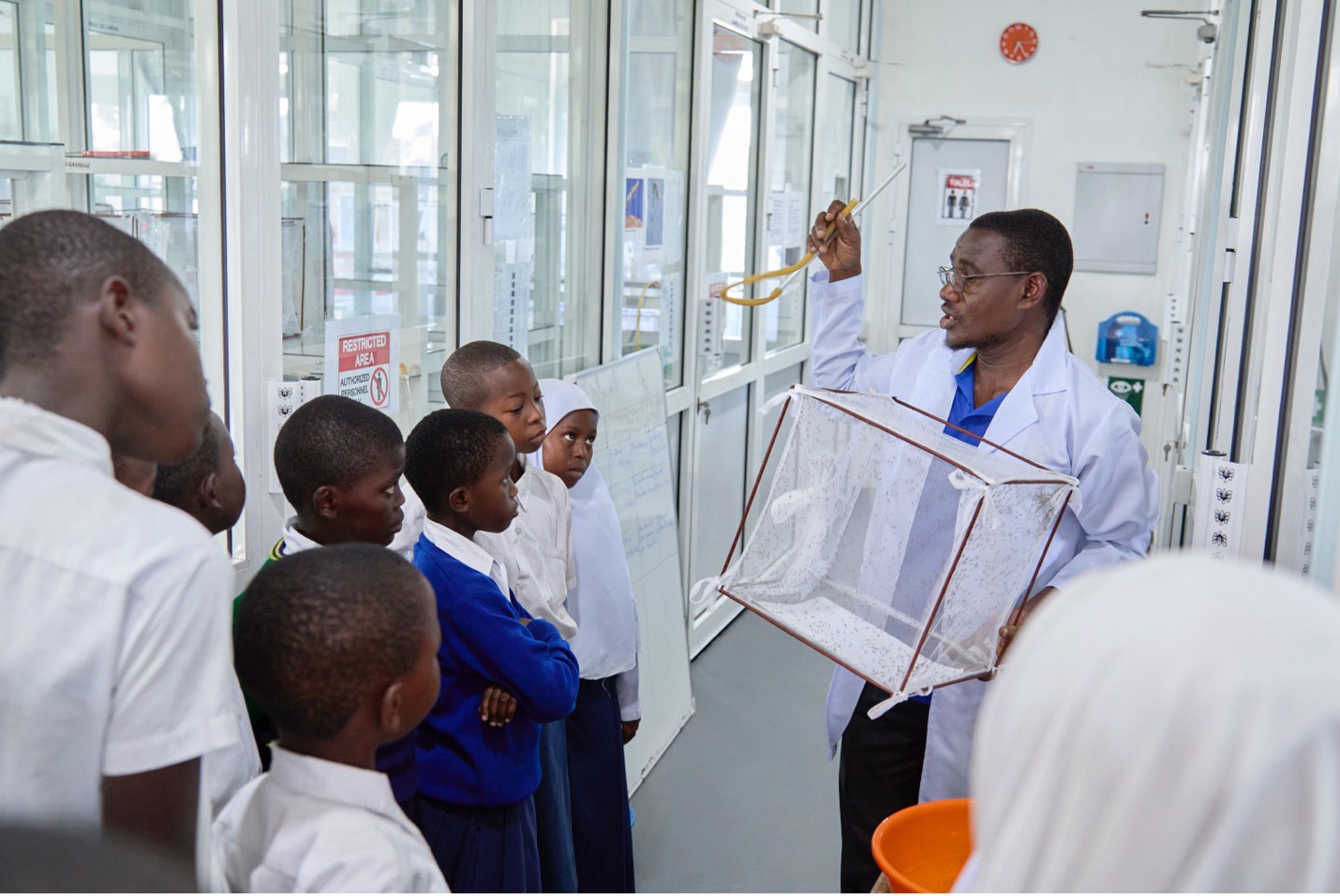
At the Bagamoyo insectary, the students were shown mosquitoes at different stages of their life cycle.
For many of the students, this was an opportunity to see something they had previously encountered only in a textbook or classroom discussion. The visit to the laboratory offered another perspective. Ahmad Bakari introduced them to ongoing experiments evaluating malaria control interventions, including research on insecticide-treated bed nets. The students did not simply watch; they asked questions.
Why do mosquitoes bite humans? Why do they spend part of their life in water? Why do we use bed nets? Why aren't bed nets black? Why does each mosquito species transmit particular diseases? And why does a mosquito bite become itchy and swollen?
These may sound like simple questions, but they opened the door to conversations about mosquito behaviour, biology, disease transmission and the science behind malaria control.
When curiosity meets research
One of the most valuable parts of the visit was the connection between what students learn at school and what happens inside a research institute. A lesson about the mosquito life cycle can feel very different when students are standing in an insectary and seeing the different stages for themselves. A discussion about malaria prevention becomes more tangible when they see researchers testing the tools used to protect people from the disease. These experiences can help make science feel less distant. They also give young people an opportunity to see that the questions they ask in a classroom can lead to real scientific investigation.
For the teachers who accompanied the students, this was an important part of the experience. They welcomed the opportunity and suggested that similar engagements could be organised regularly. Bringing students into research environments, they noted, can strengthen classroom learning, encourage curiosity and expose young people to possible careers in science.
Planting curiosity early
Community engagement in health research is often discussed in terms of reaching communities with information or involving them in research activities. There is also value in creating opportunities for young people to encounter science early, ask questions and see the people behind the research. The Bagamoyo visit offered exactly that. For a few hours, the students moved from the classroom into the insectary and laboratory, meeting researchers and seeing malaria research in action.
Perhaps the most important outcome was not how many facts they remembered about mosquitoes, but the questions they left with.
Curiosity is often where learning begins. And sometimes, bringing science closer to young people is enough to make them wonder what they might discover themselves.