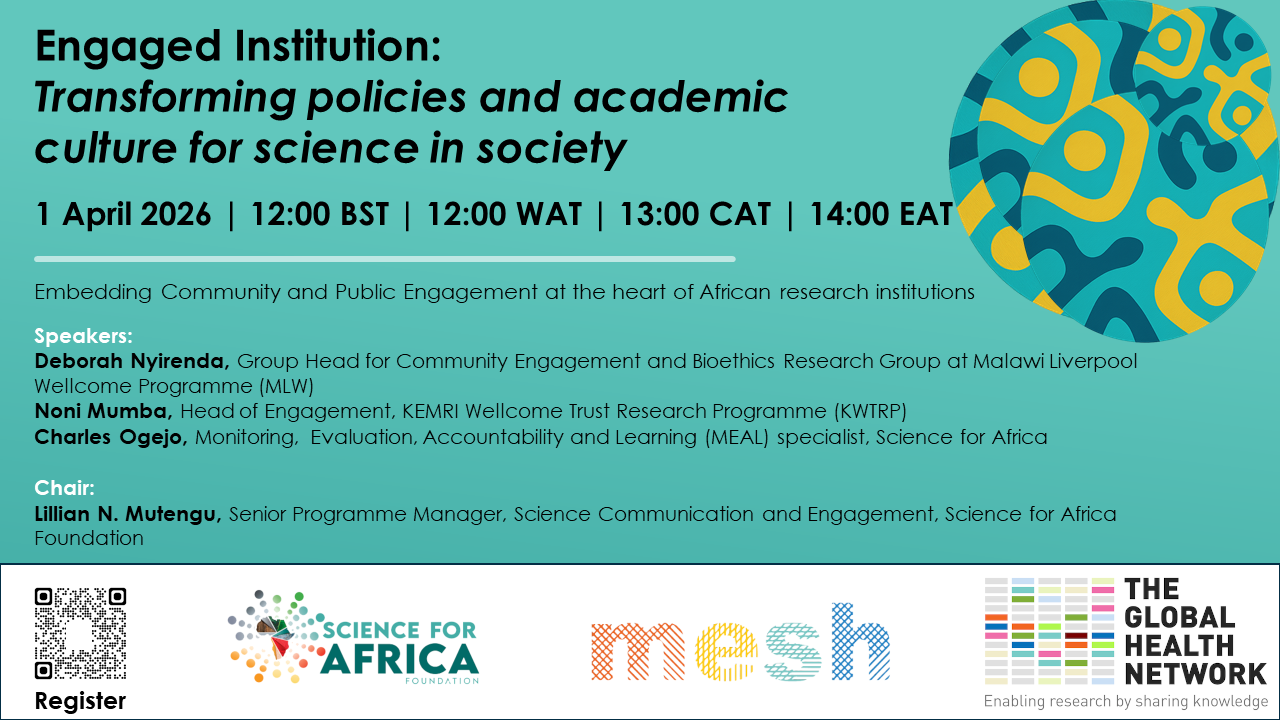
The traditional "ivory tower" model of scientific research is increasingly being replaced by a paradigm that values inclusivity, trust, and societal relevance. While Community and Public Engagement (CPE) has garnered attention as a critical element of the research ecosystem, its implementation often remains peripheral in research functions. In this second webinar of a four-part series, we sustain discussion on how to "Institutionalize" CPE within the African research context. This webinar will explore the necessary "systemic turn" required to shift CPE into a structural, sustainable part of the scientific research system - from organizational strategy, to developing Standard Operating Procedures (SOPs), and building the evidence base through Monitoring, Evaluation, Accountability and Learning (MEAL).
Speakers:
Lillian Mutengu is the Senior Programme Manager for Science Communication and Engagement at the Science for Africa Foundation. She leads initiatives that promote effective communication of research and fosters meaningful dialogue between scientists, policymakers, and the public across Africa, to strengthen evidence-informed decision-making and inclusive scientific engagement.
Charles Ogejo is a Monitoring, Evaluation, Accountability and Learning (MEAL) specialist currently serving as a MEAL Officer at the Science for Africa Foundation. With over a decade of experience, his work focuses on building scalable systems that collect, analyze, and synthesize evidence into actionable insights that inform decision-making and drive meaningful impact. Beyond the scientific research ecosystem, Charles has worked extensively within nonprofit organizations across Sexual and Reproductive Health, Democracy, Human Rights, and Governance sectors. He is deeply passionate about data storytelling - the art and science of transforming numbers into compelling narratives that inspire learning, accountability, and action. In his role, Charles is committed to ensuring that programme evaluation and reporting reflect the voices of communities most impacted by research, by documenting and communicating their journeys, experiences, and lessons throughout the programme lifecycle.
Dr Deborah Nyirenda is the Group Head for Community Engagement and Bioethics Research Group at Malawi Liverpool Wellcome Programme (MLW) and a Career Track Lecturer at the Liverpool School of Tropical Medicine (LSTM). Deborah is the country lead for the Global Health Bioethics Network in Malawi. She has led numerous research projects focused on critically examining community engagement in global health research and co-designing community-led health interventions. She is also a theme lead for social science, risk communication and community engagement in multi-disciplinary research collaborations including the NIHR Global Health Research Groups on Gastrointestinal Infections and Vaccines to Control Respiratory Pathogens and Antimicrobial Resistance (AMR) in Africa.
Deborah has authored more than 40 peer-reviewed articles on community engagement and related health issues in leading international journals and has contributed to book chapters. Her full publication profile is available at: https://orcid.org/0000-0002-5867-4687
Noni Mumba is Head of Engagement at KEMRI Wellcome Trust Research Programme (KWTRP). Noni is an engagement practitioner with over 10 years experience in community and public engagement for global health research in low-and-middle-income-country (LMIC) settings. This expertise also includes engaging with broader specific publics of interest, including local, national and international global health research stakeholders, including funders. Her role at KWTRP includes development of engagement strategies and innovative approaches for the engagement and involvement of host communities, stakeholders, and policy makers, in research planning, conduct and uptake of findings into policy. She also oversees monitoring, evaluation and learning of engagement activities. Prior to KWTRP, Noni has another 10 years of experience in Health Promotion and Strategic Health Communication with non-governmental health organizations across Kenya.
Noni is involved in building capacity of KWTRP engagement staff as well as researchers on engagement. In the last 5 years, this capacity strengthening has extended beyond KWTRP, through webinars, teaching engagements (University of Oxford’s Post Graduate Diploma in Global Health Research – Community Engagement Module), and collaborative research projects. She has participated in the development of community engagement learning tools and courses including the Online CEI Course on MESH (an online community engagement Community of Practice [COP] platform) and the GPP WHO Toolbox for COVID-19 Clinical Trials (among others).
She is a member of the Global Health Bioethics Network (GHBN); the National Institute of Health and care Research – NIHR’s Community Engagement & Involvement [CEI] Advisory Network; and has (co)authored several publications on community engagement and ethics. She has also been a long-standing member of NIHR funding committees (specifically Health Policy and Systems Research-HPSR). Previously, she was a member of an Ethics Advisory Board for Target Malaria a consortium looking for malaria solutions through mosquito gene editing.
She holds a Master of Arts degree in Development Communication.