
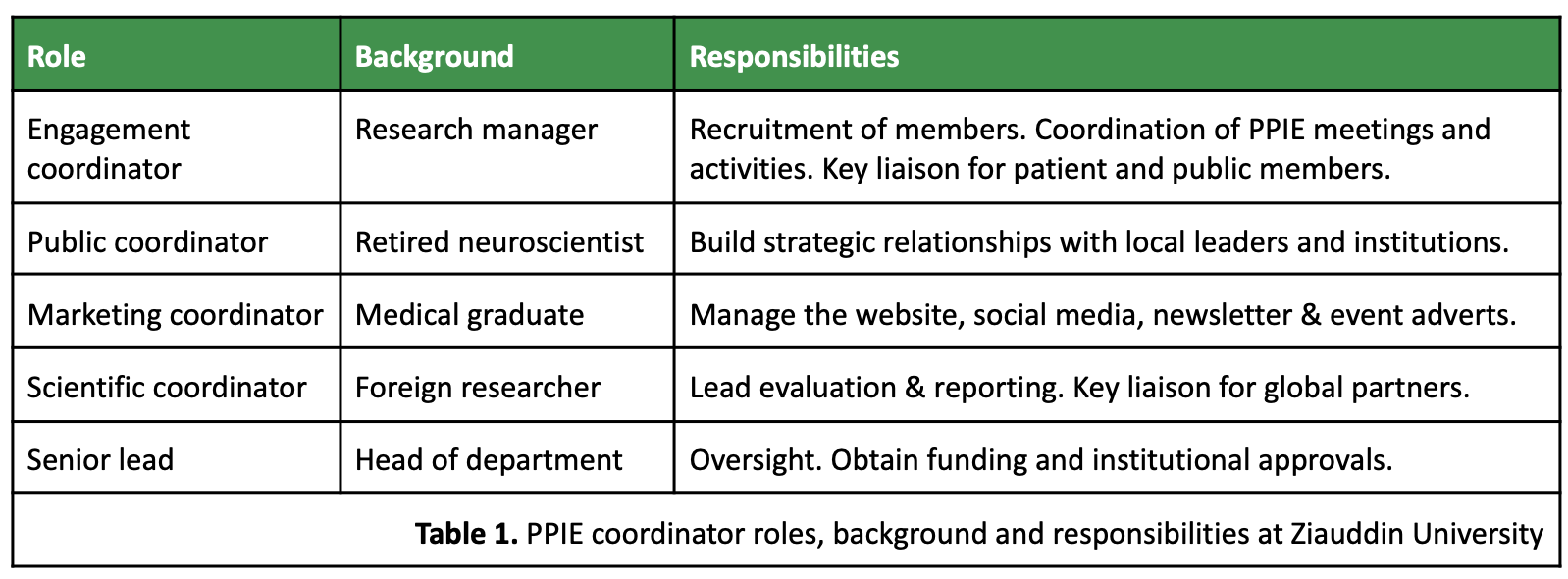
Patient and public involvement and engagement is not a simple add-on to usual research practice. Rather, it requires staff equipped with content expertise and the right set of skills. At a minimum, it is recommend that the initiative has a dedicated PPIE coordinator and a senior lead. The senior lead is needed for oversight, support with navigating institutional approvals and funding requirements, and convincing senior leadership and doctors to support PPIE. The coordinator should allocate approximately 50% of their working week to PPIE activities, particularly at the start of the initiative where significant time is spent on creating a project plan, establishing processes, recruiting members and engaging with various partners. An example job description for a PPIE coordinator can be found in Appendix A. Ideally, your PPIE initiative is managed by a diverse team with different backgrounds and responsibilities. As an example, one PPIE initiative started with three coordinators and a senior lead, with a fourth marketing coordinator joining 18 months later (Table 1). Having a team of individuals working towards a common goal is likely to be key to success, as the team are able to motivate and support each other and benefit from distinct expertise and ideas across individual members.
Once the team has been identified, an important next step is training. It is strongly recommend that all individuals involved in the PPIE initiative complete the free online course ‘An Introduction and Practical Guide to Community Engagement and Involvement in Global Health Research’ created by the Mesh Community Engagement Network and the National Institute for Health and Care Research (NIHR). A key skill to develop for PPIE is small group facilitation. Further training and reading can be found on the Mesh website and in Appendix B.
In addition to training and reading, individuals involved in PPIE are encouraged join a community of practice dedicated to engagement. Such a community offers motivation, advice and peer-to-peer support as well as opportunities for professional development, including webinars and events. The Mesh Community Engagement Network is available to all globally: https://mesh.tghn.org/