Introduction
The KEMRI-Wellcome Trust Research Programme (KWTRP) School Engagement Programme (SEP) has been actively working with schools in Kilifi for over a decade to promote interest in science and science-related careers among students. From this engagement experience, it became clear that African scientists can serve as powerful role models, helping to dismantle stereotypes and inspire young learners, particularly those from underserved communities. Life stories of scientists who have risen to prominence from humble beginnings have the potential to resonate strongly with local students. To support this vision, SEP collaborated with Dr. Tabitha Mwangi to develop an inspirational 12-chapter book titled “The 12 Remarkable African Life Scientists”, which profiles leading African health scientists and is tailored for a secondary school audience. The student engagement with the book served as the foundation for a broader, creative science literacy collaboration designed to ignite curiosity, imagination, and aspiration among young people in Kilifi County. This initiative was formally launched at St. Thomas Girls Secondary School in February 2024, with support from the Wellcome Trust, marking the beginning of an innovative effort to deepen science engagement through storytelling and representation. This brief captures the implementation of the literacy engagement with schools in Kilifi, feedback from the students and the way forward.
Planning and Implementation of the Science Literacy Engagement
The planning process was a collaborative effort between the School Engagement Programme (SEP) team, the communication team, and contact teachers from participating schools. Key outputs from this coordination included: developing the event programme, managing logistics, identifying stakeholders, designing student involvement strategies, creating a communication plan with key messages and channels, and outlining post-launch activities. During the book launch, each school presented creative interpretations of the life and work of three selected scientists: Professor Amina Abubakar Ally, Professor Elelwani Refilwe Ramugondo, and Professor Christian Happi. Students highlighted the scientists’ key achievements, experiences, and challenges through engaging formats such as poems, skits, songs, and drama. These presentations were highly inspirational and showcased the students' creativity and understanding. In addition to presenting, students had the opportunity to interact with the book’s author, Dr. Tabitha Mwangi, engaging her in a Q&A session and learning more about her journey and insights. Consequently, the engagement involved collaborating with different stakeholders for comprehensive reach, conducting early market engagement activity through open days, and documenting the open days through the media.
I. Initiating a Collaboration in Science Literacy
The science literacy collaboration was initiated in consultation with the Kilifi County Library Office and brought together other partners managing library sites across Kilifi, including KESHO Kenya, SHOFCO, Moving the Goalposts, and Pwani University. The collaboration aimed to establish an annual Science Literacy Day, held during school holidays, to engage young people with science literature and encourage meaningful interactions with scientists.
II. Science Literacy Open Day: Expanding Reach Beyond the School Term
Following the book launch, a Science Literacy Open Day was subsequently held as a follow-up event. This collaborative initiative was organised by Kilifi County Library Services, the KEMRI-Wellcome Trust Research Programme (through its School Engagement Programme), Pwani University, Moving the Goalposts (MTG), SHOFCO, and KESHO Kenya. The primary aim of the event was to promote the readership of the 12 Remarkable African Life Scientists among students in Kilifi County and inspire their interest in science. Unlike SEP’s regular engagement during school terms, this event leveraged Kilifi County Library Services to reach students during the school holidays, providing a valuable opportunity to engage a broader audience and extend the programme’s impact beyond the classroom.
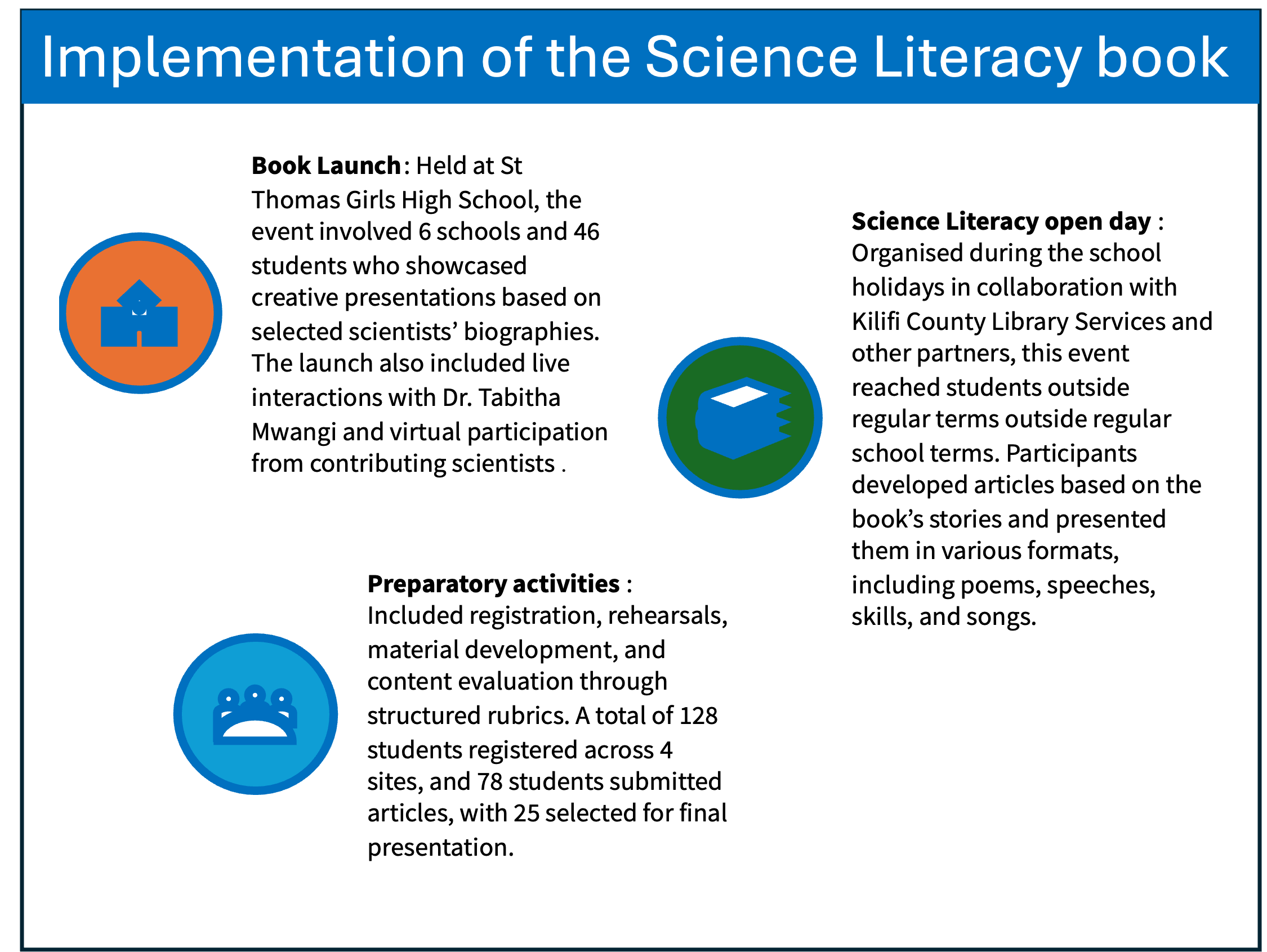
The diagram above shows the three aspects of the science literacy programme. The engagement began with the launch of the book, where students showcased creative presentations on selected scientists, followed by the literacy open day, where 78 students participated (56 girls, 22 boys), developing 51 articles. Rehearsals were conducted by the coordinating committee, and the articles were assessed by a panel of 16 evaluators drawn from various organisations. A standardized rubric was used to evaluate articles focusing on creativity, presentation skills, and relevance. After the evaluation, 25 articles were selected for the final presentation during the Open Day. The open day attracted a total of 199 participants, including 142 students, 9 parents and 48 government officials and stakeholders. 18 student articles were presented in Speeches (8), Poems (5), Song (1), Group narration (1), Skits (2) and Mimicry (1). The top 15 students received scientific calculators, and all participants were awarded geometry sets, wristbands, pens, and certificates. Students also had the opportunity to interact with guest speakers from various institutions. The Kilifi County CECM for Gender and Youth delivered the keynote address, sharing her journey as a scientist. She encouraged students to cultivate a reading culture, have confidence in themselves, and embrace science without pressure to define their futures too early.
III. Documentation and Media Engagement
The event was documented through video recordings of student presentations and scientist profiles. Although there was an initial plan to showcase these videos during the Open Day, time limitations did not allow for this. However, the event received media coverage through local stations and online platforms (e.g., Twitter/X). To preserve these efforts and extend the impact, Student articles will be compiled into a scrapbook, and videos will be organised into a digital video library for future reference and learning.
IV. Partnerships
This initiative was made possible through strong multi-sectoral collaboration. The collaborative approach ensured wide reach and enhanced community ownership. Key partners included:
- Kilifi County Library Services (KCLS): Co-hosted events, facilitated student mobilization, and chaired planning meetings. The majority of the students learned about the event through Kilifi County Library Services 47 (51.6%). Other notable sources included SHOFCO 18(19.8%) and MTG 16(17.6%) and KESHO Kenya 10(11.0%),
- Pwani University: Provided scientists and guest speakers.
- KESHO Kenya, MTG, SHOFCO: Mobilised and prepared students, supported logistics, and contributed resources and awards.
- KEMRI-Wellcome Trust SEP: Led coordination, provided technical support, resources (books, awards), and documentation.
V. Progress So Far
- Reach: 128 students registered; 78 submitted articles; 199 attendees at the Open Day (including 142 students).
- Engagement Quality: Students presented a wide range of content, demonstrating high creativity and critical engagement with the book’s themes.
- Feedback Highlights:
- 90% of students felt inspired to pursue science.
- 97.8% would recommend the event to peers.
- Students expressed a strong desire for increased access to books, more preparation time, and improved logistics (e.g., meals, presentation time).
- Stakeholder Feedback: Emphasised the value of cross-organizational collaboration, but also identified areas for improvement (e.g., planning rehearsals, better photo documentation, inclusion of students with disabilities).
Students’ Feedback on the Science Literacy Open Day: As part of the post-event evaluation, students were asked to suggest one thing they would change or improve for future events. The feedback was grouped into three themes:
1. Attitude and Behaviour Change: Many students expressed commitment to personal and academic growth, including a renewed interest in science subjects and improving their learning habits.
“I will change my attitude towards science.”
“I will change and improve in my work at school.”
2. Confidence and Presentation Skills: Students reflected on their presentation experience and identified areas for self-improvement, particularly in public speaking, creativity, and delivery.
“I will make sure that I build more confidence.”
“I would improve the creativity in our presentations to make them more interesting.”
3. Time Management and Participation: A common suggestion was to allocate more time for preparation and presentation, to allow students to better rehearse and for more participants to present.
“To increase the time for preparation.”
“More time is required for all to participate.”
Recommendations
To sustain and grow the impact of this initiative, the following actions are planned:
- Annualization of the Science Literacy Open Day to build consistency and anticipation among students and partners.
- Expand Book Distribution across more schools and community libraries to widen access to inspiring scientific role models.
- Formalise Committees: Two committees have been established; one for concept development and another for planning, to streamline future events.
- Inclusion and Accessibility: Future activities will be more intentional about including students with disabilities and enhancing equity in participation.
- Enhanced Publicity: Utilise social media, local radio, and TV to broaden the visibility of student work and encourage community support.
- Partner Mapping and Resource Mobilisation: Engage more stakeholders to contribute resources, mentorship, and expertise.
Conclusion
This science literacy initiative has shown the powerful impact of storytelling and creative engagement in inspiring the next generation of African scientists. With continued collaboration and refinement, the programme is poised to grow into a flagship model of educational innovation and youth empowerment.
``` If you want the image to be exactly 25% of the *container* instead of the viewport, change the `.cover-right { width: 25vw; }` to `.cover-right { width: 25%; }`. Tell me which you prefer and I’ll tweak it.